
If you live in Pakistan you already know the problem. The voltage sags until the fan slows, then swings back up and the bulbs glare. Generators and solar inverters make it worse at the moment they switch. Over months, that is what quietly kills fridges, air conditioners, televisions and computer power supplies — not one dramatic spike, but hundreds of small ones.
What actually damages an appliance
Three separate things, and it is worth knowing which is which:
- Over-voltage. Supply climbs above ~250V. Insulation and capacitors are stressed; power supplies fail early.
- Under-voltage. Supply sags below ~170V. This is the one people underestimate — a fridge or AC compressor tries to start, cannot, and draws heavy current while stalled. That is how compressors burn out.
- Over-current. Too much load, or a fault. Your MCB covers this, but only at its own threshold.
A voltage and current protector covers all three, and it does it by simply opening the circuit until conditions are safe again.
Where it goes in your board
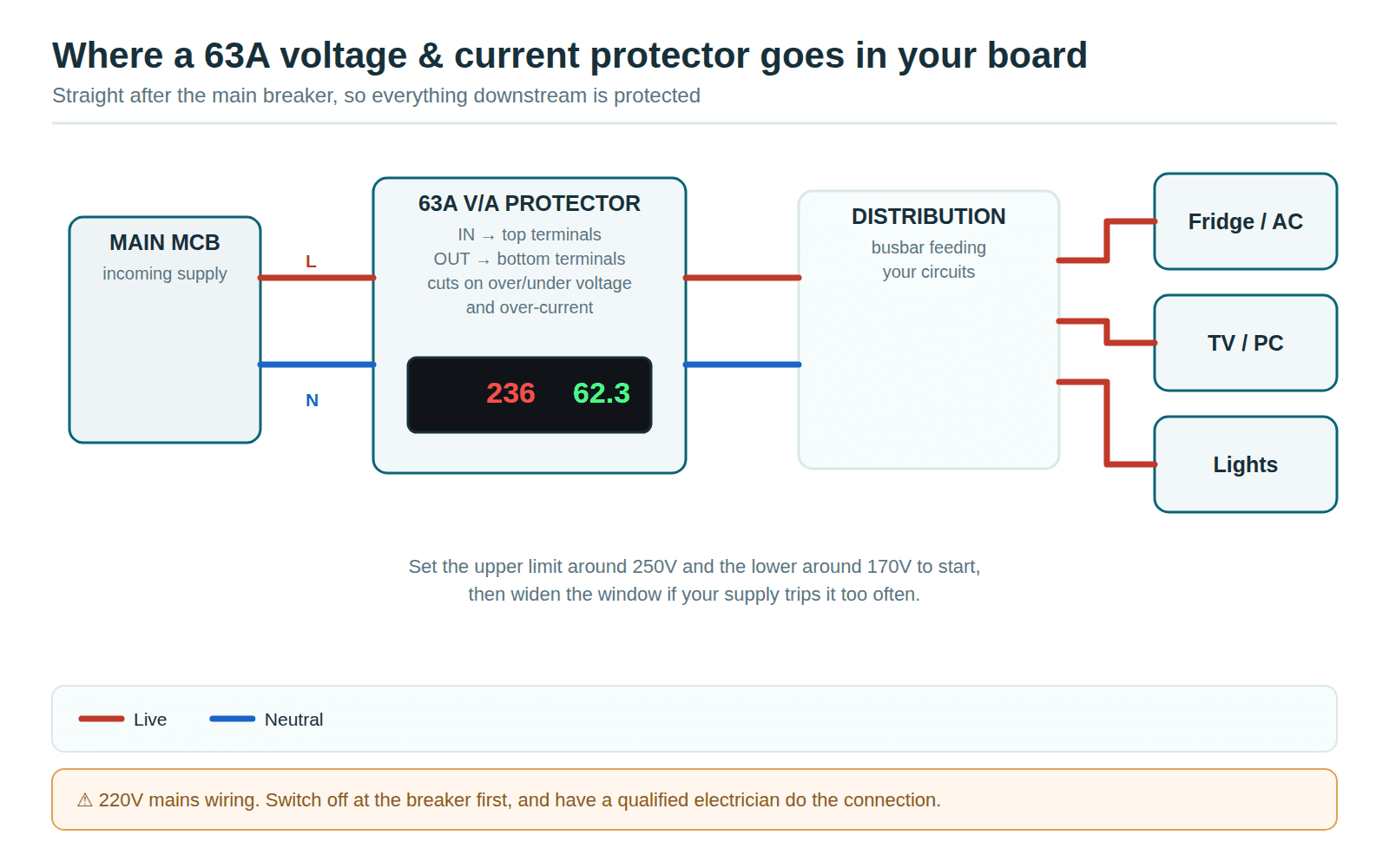
It clips onto the DIN rail immediately after your main breaker. Supply comes into the top terminals, and the protected output leaves the bottom terminals to your distribution busbar. Everything downstream is then covered by one device.
Voltage protector vs stabiliser vs UPS — they are not the same thing
| What it does | What it cannot do | |
|---|---|---|
| Voltage protector | Disconnects when voltage or current goes out of range; reconnects automatically | Does not correct the voltage — the power simply goes off |
| Stabiliser | Corrects moderate swings so the appliance keeps running | Limited range; will pass through a severe fault |
| UPS / inverter | Keeps things running when the supply fails | Does not protect against a bad supply, and often is the source of the switching spike |
They complement each other. The protector is the cheapest of the three and the only one that guards the whole house at once, which is why it is the right first purchase.
Reading the display
The unit shows live voltage and live current, which turns out to be genuinely useful even when nothing is wrong. You can watch what your supply actually does through the evening, and you can see the current jump when the AC compressor kicks in. If you have ever wondered whether your voltage complaint is real, this settles it.
Setting it up
- Upper voltage limit: start at 250V. Most appliances are fine to 250V; going much higher defeats the purpose.
- Lower voltage limit: start at 170V. Below this, motors struggle.
- Over-current limit: set it at or just under your main breaker rating — do not set 63A on a 32A supply.
- Reconnection delay: 30–60 seconds is a good default. A short delay is hard on fridge and AC compressors, which need time for pressure to equalise before restarting.
If it trips more often than you can live with, widen the voltage window a little rather than switching the protection off. If it never trips at all, your supply is better than you thought — leave it alone anyway, because it costs nothing to have it there.
⚠ This connects to your main distribution board. Have a qualified electrician install it. This is not a DIY job even if you are comfortable with lighting circuits.
Is it worth it?
One 63A protector costs about the same as a single service call on an air conditioner, and far less than one compressor. If your area has visible voltage problems — lights that dim and brighten, a fridge that clicks and struggles, appliances that have already failed early — it pays for itself the first time it does its job.
If your supply is genuinely stable, it is optional. Most of Rawalpindi and Islamabad is not that lucky.
Frequently asked questions
Does it protect against lightning?
No. That needs a surge protection device (SPD), which is a different component. This protects against sustained over/under voltage and over-current.
Will it reconnect on its own?
Yes — that is the point of the adjustable delay. You do not have to go to the board and reset anything.
Can I put it on just one circuit?
Yes. Fit it on the AC or fridge circuit alone if you only want to protect the expensive loads.
63A — is that the right size for a house?
For a typical domestic supply, yes, and it gives headroom. What matters is that you set the current limit to match your actual main breaker.
Related guides
Get the parts
The Adjustable Voltage & Current Protector 63A is in stock at Smart Home | Arduino Corner — Shaheen Market, DAV College Road, Rawalpindi. Come and see the live display on the counter, or order online with cash on delivery anywhere in Pakistan.